
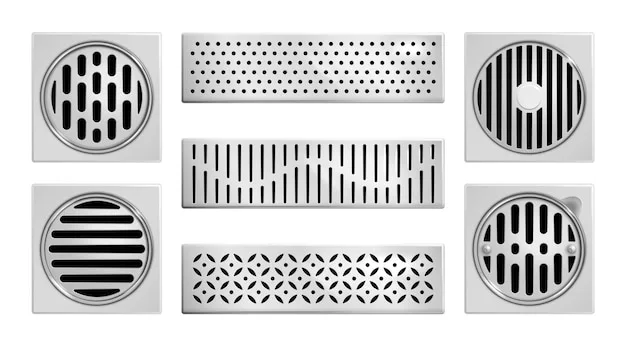
Grilles and Diffusers play a critical role in how air moves, distributes, and performs within an HVAC system. While mechanical equipment generates airflow, it is the terminal components – grilles and diffusers – that determine how effectively conditioned air reaches occupied spaces.
In modern buildings, comfort, air quality, and system efficiency depend heavily on correct air distribution. Poorly selected or incorrectly positioned outlets can cause uneven temperatures, drafts, noise, and pressure imbalance. A well-designed HVAC system treats air delivery as a precision task, not an afterthought.
Why Are Grilles and Diffusers Essential in HVAC Systems?
Air distribution is as important as air generation. Even the most efficient HVAC system underperforms when airflow is poorly delivered.
Grilles and diffusers ensure:
- Controlled air supply and return
- Even air distribution across occupied zones
- Reduced drafts and stagnant air pockets
- Proper pressure balance within the system
Without correctly selected AC grills and diffusers, airflow becomes unpredictable, directly affecting comfort and system stability.
Grilles and diffusers ensure:
Indoor comfort depends on airflow velocity, direction, and diffusion. Grilles and diffusers manage these factors at the final delivery point.
Key comfort contributions include:
- Even temperature distribution across rooms
- Reduced direct airflow impact on occupants
- Balanced mixing of conditioned and room air
- Stable airflow patterns throughout the space
An accurately selected AC diffuser grill disperses air gradually, preventing discomfort while maintaining effective cooling or heating.
What Is the Difference Between Grilles and Diffusers?
Although often grouped together, grilles and diffusers perform distinct functions within HVAC systems.
Grilles are primarily used for:
- Air return or exhaust
- Allowing air to move back to the syste
- Protecting duct opening
Diffusers are designed for:
- Supplying conditioned air into rooms
- Controlling airflow direction and spread
- Reducing air velocity at the outlet
Correct pairing of ac grills and diffusers ensures airflow moves efficiently from supply to return without imbalance.
Why Placement and Design Matter in System Performance
Improper placement leads to airflow short-circuiting, uneven cooling, or pressure inconsistencies. HVAC system design must account for room geometry, ceiling height, and occupancy patterns.
Proper design ensures:
- Uniform air coverage across the space
- Effective mixing without dead zones
- Reduced noise from airflow turbulence
- Improved system efficiency over time
This is why system designers often coordinate closely with grilles and diffusers manufacturers in the UAE to match products with design intent and building requirements.
Can Grilles and Diffusers Affect Energy Efficiency?
Yes. Air distribution efficiency directly impacts energy consumption. Poor airflow forces HVAC equipment to work harder to compensate for uneven temperatures.
Efficient air delivery helps:
- Reduce thermostat overcorrection
- Maintain stable room temperatures
- Lower system runtime and energy load
- Improve overall HVAC efficiency
Selecting the right ac diffuser grill helps maintain comfort without unnecessary energy waste.
Why Material and Build Quality Matter
Grilles and diffusers are exposed components that operate continuously. Low-quality materials degrade faster, affect airflow accuracy, and increase maintenance needs.
High-quality products offer:
- Long-term dimensional stability
- Consistent airflow performance
- Resistance to corrosion and deformation
- Clean appearance over extended use
Professional HVAC projects rely on trusted grilles and diffusers manufacturers in UAE to ensure durability and performance consistency.
How Do Grilles and Diffusers Support Indoor Air Quality?
Air distribution affects how pollutants, humidity, and stale air are removed from occupied spaces.
Effective design helps:
- Prevent air stagnation
- Improve fresh air circulation
- Reduce moisture accumulation
- Support cleaner indoor environments
Correctly specified AC grills and diffusers ensure that ventilation air reaches all occupied areas, supporting healthier indoor conditions.
Conclusion
Grilles and diffusers are not decorative elements; they are functional components that directly influence comfort, efficiency, and system reliability. From airflow direction to pressure balance, their role is foundational in HVAC system design.
Choosing the right Grilles and Diffusers, paired with correct placement and quality manufacturing, ensures that HVAC systems deliver air where it is needed – consistently and efficiently.
For projects requiring dependable air distribution components, Air Cold Ventilation works closely with reliable supply partners to ensure precise product selection aligned with system design and performance requirements.
Make airflow work as intended – down to the final outlet.
FAQs
1. What role do grilles and diffusers play in HVAC systems?
They control how air enters, moves through, and exits occupied spaces.
2. Are AC grills and diffusers used for both supply and return air
Yes. Diffusers supply air, while grilles commonly handle return or exhaust.
3. Does an AC diffuser grill affect room comfort
Yes. It regulates airflow direction, speed, and distribution.
4. Why choose experienced grilles and diffusers manufacturers in UAE
They provide products designed for durability, accuracy, and regional requirements